President Donald Trump seems to relish the idea of cultural elites turning up their noses at his Kennedy Center honorees.
On Wednesday, after motorcading through streets patrolled by federal agents and army reservists at his direction, he revealed the list of stars who will be celebrated at the Kennedy Center’s annual gala later this year.
The lineup says much about Trump — his tastes, his power, and why he’s president.
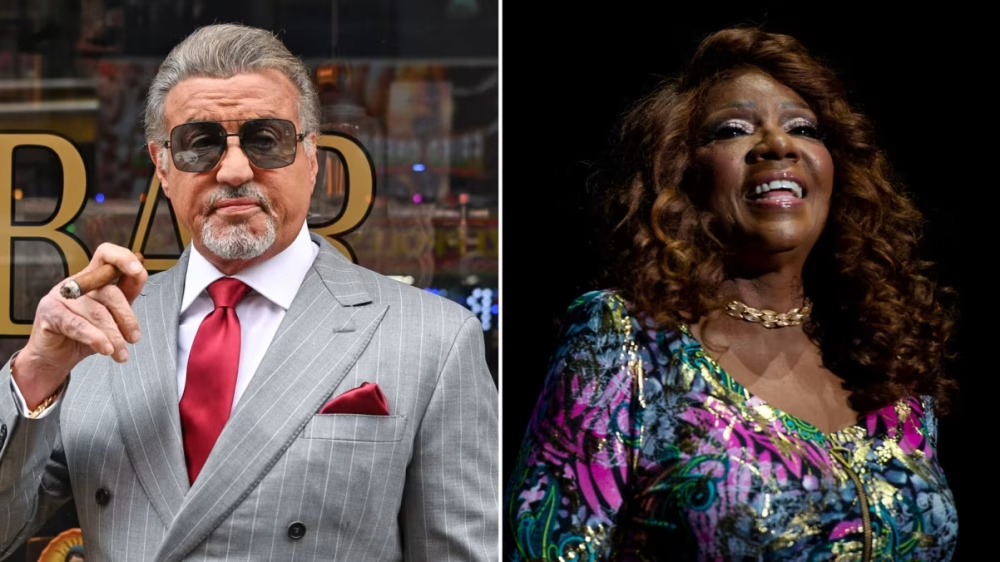
“Rocky” icon Sylvester Stallone, Broadway legend Michael Crawford, disco queen Gloria Gaynor, country star George Strait, and glam rockers KISS lean more toward populist entertainment than “high” culture. That doesn’t make them unworthy — Stallone’s “indelible” mark on cinema easily meets the honors’ criteria — but it reflects a trend toward popular art that’s been growing for decades under presidents from both parties.
As always, Trump’s choices carry a political edge. Any criticism as “lowbrow” only reinforces his image as the scourge of the establishment and cements his appeal to supporters who see him as the ultimate outsider.
Critics frame this as part of his cultural war — an attempt to reshape the arts, academia, and other institutions in his own mold. Trump himself has said he removed any potential honorees he deemed “woke” and even toyed with the idea of giving the award to himself.
That’s why some see him as a would-be authoritarian eager to dictate every aspect of American life. Typically, presidents don’t handpick the honorees — they show up for the reception and the show. But Trump, a lifelong consumer of pop culture and self-styled producer of his own political brand, seized the chance to control the spotlight. He even plans to host the televised gala himself, claiming he was persuaded by Chief of Staff Susie Wiles — though it’s hard to imagine much persuasion was needed.
Turning the Arts into Politics
Trump’s control over the Kennedy Center marks another win for his “Make America Great Again” movement and its push to reclaim — or, as critics say, politicize — cultural institutions.
“I would say I was about 98 percent involved,” he boasted. “They all went through me … I turned down plenty. They were too woke.”
For many conservatives, liberal elites have long dominated the arts, media, academia, and sports, dragging them leftward. Trump’s defiance of that establishment — the same establishment that mocked his brash style — is part of why his supporters embraced Hillary Clinton’s “deplorables” label in 2016 as a badge of honor.
In their eyes, when Trump takes over an institution, he’s not corrupting it — he’s reclaiming it. And on conservative media, stars who voice progressive views in Hollywood or professional sports are often attacked as “ruining” their fields.
Before Trump, honorees were selected by a bipartisan panel from the arts and entertainment world. To Trump’s base, these panels were hardly neutral, given their liberal leanings. By personally overseeing the list, Trump signaled he was reshaping the Kennedy Center in his own image.
“I shouldn’t make this political because they made the Academy Awards political, and they went down the tubes,” he said. “But I think if we make it our kind of political, we’ll go up.”
Still, critics say the move fits a troubling pattern. In isolation, his micromanaging of the Kennedy Center might seem eccentric; in context — alongside his attacks on judges, federal takeover of DC policing, and efforts to reshape museums and universities — it suggests a broader effort to control what Americans see, learn, and do.
How the Honorees Reflect Trump
It’s easy to imagine Trump handpicking this roster, since each reflects something about his own persona.
Stallone’s Rambo and Rocky defy political correctness — much as Trump sees himself doing. “He’s a little bit tough, a little bit different,” Trump said, noting that both men have stars on the Hollywood Walk of Fame.
George Strait embodies traditional, rural America — a cultural vein Trump often taps.
Michael Crawford, famous for “Phantom of the Opera” and “Barnum,” recalls Trump’s love for musicals that were popular with the masses but looked down on by elites. “Barnum” itself — about the showman and impresario who blurred the line between truth and spectacle — reads like a blueprint for Trump’s public life.
KISS brings bombast and spectacle to the stage — traits Trump has embraced for decades.
And Gloria Gaynor’s “I Will Survive” might as well be Trump’s own anthem, reflecting a career and presidency that have survived countless scandals.


