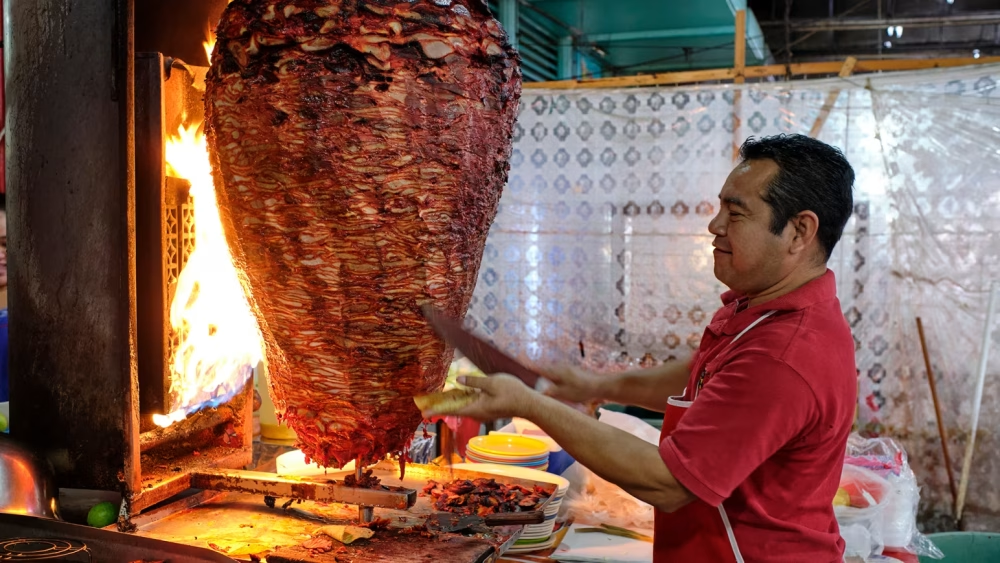
Spit roasting—skewering meat on a turning spit over fire—stands among humanity’s most enduring culinary traditions. Historians like Ken Albala point to its deep roots, with food scholars noting its presence in some of the earliest human cooking techniques.
The technique’s origins are vividly described as far back as Homer’s Iliad, where celebratory feasts featured spit-roasted meats during the final moments of the Trojan War. Over centuries, the method traversed civilizations—from Greece and Rome, where it was detailed by authors like Virgil, Cicero, and Pliny the Younger—to medieval Europe, where taverns relied on “spit boys” to manually rotate meats over hearths for communal meals.
By the 19th century, innovation reshaped the practice with Turkey’s vertical spit roaster. Chef İskender Efendi of Bursa applied vertical cooking to sliced lamb, birthing the now-iconic döner kebab. This culinary invention sparked countless global variations—shawarma in the Middle East, gyros in Greece, and al pastor in Mexico—each adapted to local tastes while retaining the spin-and-carve essence.
Even today, spit-roasting thrives across cultures. In Hong Kong, the Cantonese delight siu mei—roasted meats over open flames—remains a daily staple, from char siu to roast goose, eaten every few days by many locals. Elsewhere, the Mediterranean continues a rich tradition: Sardinia’s spit-roasted learn porchetta (poceetto) is slow-cooked on embers for hours, its succulent flavor born from drizzling lard and seasoning with myrtle. In South America, the Argentinian asado al palo features whole lambs roasted vertically over open coals—a feast that’s as much tradition as it is meal.
For Southeast Asia, spit-roasted dishes are both heritage and street-food staple. Iconic recipes like satay—infused with spices, grilled over charcoal and served with rich peanut sauces—are an adaptation of the kebab tradition, brought by Indian and Arab traders into the region in the 18th century. Today’s culinary landscape in countries like Malaysia, Singapore, and Indonesia blends this age-old technique with modern flair, fueling vibrant hawker scenes and culinary tourism.
Beyond taste, spit-roasting embodies food’s social dimension—rooted in communal tables, ritual, and shared experience. As global diners seek both authenticity and ingenuity, this form of slow, purposeful cooking resonates as much for its heritage as its flavor.


