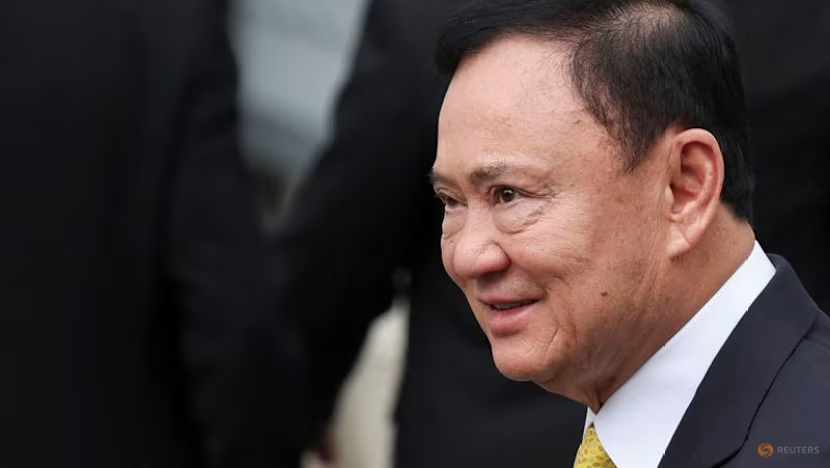
BANGKOK / KUALA LUMPUR, 29 September 2025 — Former Thai Prime Minister Thaksin Shinawatra, aged 76, has formally submitted a petition for a royal pardon following the Supreme Court’s order for him to serve a one-year prison sentence. His lawyer confirmed the request as a legally permissible recourse for inmates who have exhausted appeals.
Thaksin was ordered back to jail earlier in September after the court ruled that his hospital detention, following his return to Thailand, could not count toward his sentence, branding it an attempt to circumvent incarceration. Originally, he had been handed an eight-year sentence for abuse of power and conflicts of interest during his 2001–2006 tenure, but that was commuted to one year by royal decree.
His lawyer, Winyat Chartmontree, told reporters, “The petition was submitted. This is a right of every inmate.” The pardon petition must be processed through Thailand’s corrections and justice departments before being submitted to the king.
Political Fallout & Broader Context
Thaksin’s return to prison marks a dramatic escalation in a saga that has defined Thai politics for decades. After spending 15 years in self-imposed exile, he returned to Thailand in August 2023. Initially, he entered custody briefly, but was transferred to hospital care, where he remained—reportedly under medical treatment—before being granted parole. That hospital stay is now judged by the Supreme Court to have been illegitimately used to avoid serving a full term.
Under the latest ruling, he was escorted to Klong Prem Central Prison to begin serving the one-year term mandated. Reports suggest the prison is a challenging environment—housing some 6,500 inmates, with shared sleeping areas and minimal privileges for most inmates. Thaksin may be housed with other older political prisoners, but his status ensures heightened scrutiny and concern for his security.
Politically, this development deepens the crisis for the Shinawatra dynasty. Thaksin’s daughter, Paetongtarn Shinawatra, was recently removed as prime minister following an ethics ruling, weakening the family’s hold on power. Analysts suggest that the legal pressure now stacking on the family could reshape Thailand’s key political fault lines.
Key considerations include:
- Institutional credibility: How the royal pardon is handled may test Thailand’s judicial independence and the balance between monarchy, judiciary, and executive influence.
- Policy continuity: If political turbulence deepens, it may slow or derail economic reforms, infrastructure projects, or foreign investment commitments.
- Investor sentiment: Capital might favor jurisdictions with more predictable legal and political frameworks, especially in Southeast Asia.
In short, while the pardon petition could reduce the duration of Thaksin’s immediate confinement, it does not erase the broader implications: the episode may leave lasting impressions on Thailand’s political landscape and investor confidence.


