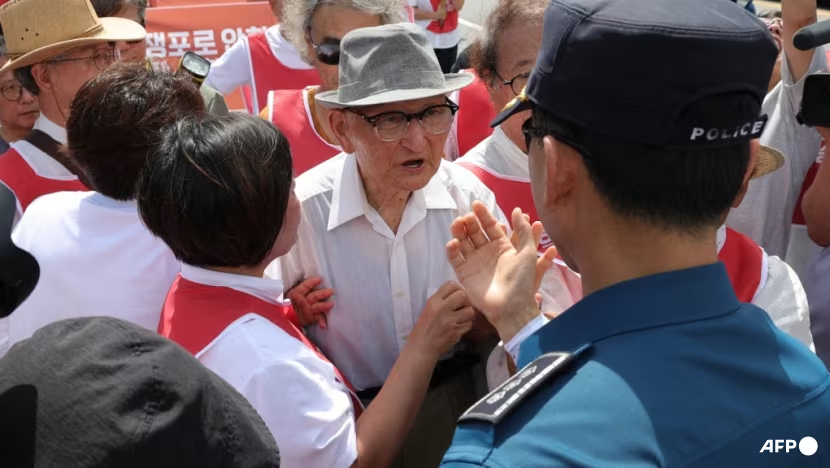
On August 20, 2025, a dramatic scene unfolded at the inter-Korean border as South Korean soldiers intercepted 95-year-old Ahn Hak‑sop, a former North Korean spy, just steps away from crossing into the North. Ahn, flanked by a North Korean flag, had approached the military checkpoint on Tongil Bridge aiming to return to his homeland—a plea that was firmly halted by border guards. He was escorted to a hospital thereafter, according to a spokeswoman for the civic group advocating his cause.
Ahn is not alone. He represents one of six elderly former North Korean soldiers and spies—now in their 80s and 90s—who once served decades in South Korean prisons for refusing to abandon their communist ideology. These individuals, often referred to as “unconverted,” have intensified their calls for repatriation to North Korea, arguing that they should be regarded as prisoners of war and their requests honoured under the Geneva Conventions.
Captured during the Korean War in 1953 under espionage orders, Ahn remained incarcerated until 1995—his sentence could have been shorter had he renounced his beliefs. Reflecting on his enduring conviction, Ahn remarked in a 2024 interview, “I am a prisoner of war who came here in a North Korean military uniform under orders from the Workers’ Party. But the South Korean government did not treat me as such, and I was forced to spend more than 40 years in prison, subjected to numerous tortures.”
Seoul’s Unification Ministry confirmed receipt of these repatriation requests and noted that authorities are “reviewing various ways to address the issue.” While no final decision has been reached, the possibility of more former convicts in similar positions pressing for repatriation looms on the horizon—though the government lacks a clear tally of how many such individuals remain.
Historically, South Korea has repatriated “unconverted” prisoners before—most notably in 2000, when 63 individuals were sent back via Panmunjom during a rare period of inter-Korean thaw. To date, that remains the sole event of its kind.
Source: CNA


