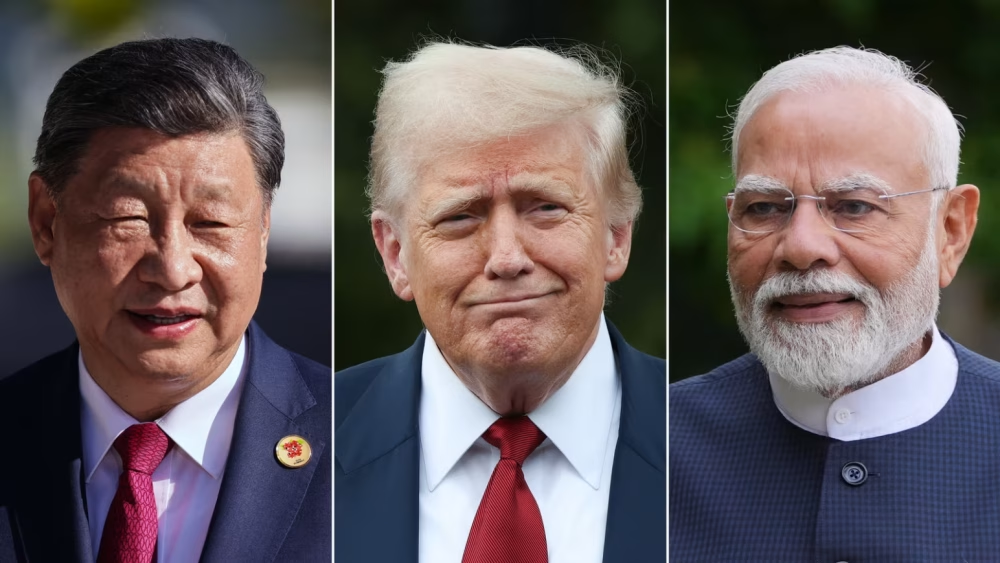
India and China share a long, fraught history marked by bloody border clashes, a stark power imbalance, and an ongoing battle for influence across Asia. Yet, former US President Donald Trump’s latest trade measures may be achieving the improbable: nudging these uneasy rivals toward a cautious, tactical alignment.
Trump’s announcement of a 25% base tariff on Indian goods—set to climb to 50% as additional punishment for buying Russian oil—mirrors the sustained pressure he has placed on China. This common economic challenge now gives New Delhi and Beijing a shared interest in managing a volatile and unpredictable Washington that treats allies and adversaries alike with transactional disdain.
While a tentative thaw in India–China relations was already in motion, analysts say Trump’s actions have accelerated the shift. But the rapprochement is fragile—more a marriage of convenience than a meeting of minds.
Indian Prime Minister Narendra Modi is reportedly planning to attend the Shanghai Cooperation Organization summit in China later this month, his first visit there in seven years. Beijing has openly welcomed him, with Chinese Foreign Ministry spokesperson Guo Jiakun expressing hopes the Tianjin gathering will foster “solidarity, friendship, and fruitful results.”
Yet beneath the polite diplomacy, deep-rooted distrust endures—born from decades of border disputes and competition for regional dominance. For now, their alignment stems less from shared vision and more from a shared antagonist in the White House.
A Strain in US–India Ties
India’s relationship with the United States has transformed dramatically—from Cold War estrangement to strategic partnership. Under Modi, ties deepened further, bolstered by personal rapport with Trump during his first term. This alignment became even more critical after deadly 2020 clashes with China soured relations between Asia’s two largest nations.
The Biden administration built on that momentum, positioning India as a democratic counterbalance to Beijing, often downplaying concerns over India’s domestic politics.
Trump’s return to office, however, brought a more aggressive “America First” stance—one that extended punitive measures beyond China. His public rebuke of India over Russian oil imports, coupled with record-high tariffs, has rattled New Delhi.
By treating India as a transactional adversary, Washington risks undermining a cornerstone of its Indo-Pacific strategy. “These moves have created a massive trust deficit on the Indian side,” said Milan Vaishnav of the Carnegie Endowment for International Peace.
India has pushed back strongly, calling the tariffs “unfair” and pointing out that the US and Europe still import Russian goods. Officials reject Trump’s label of India as a “tariff king,” noting that many key US exports enter India with low or zero duties.
The political fallout is evident. Modi, under pressure to defend national interests, recently declared, “India will never compromise on the interests of farmers, fishermen, and dairy farmers… I know I will have to pay a heavy price for it, but I am ready.”
From Rivalry to Limited Cooperation
Despite their tensions, India and China have been quietly rebuilding limited ties. Since Modi’s meeting with Chinese President Xi Jinping at last year’s BRICS summit, the two sides have restored direct flights, reopened Tibetan pilgrimage routes for Indians, and resumed tourist visa issuance.
Economic factors also play a role. India, facing slower growth and weaker foreign investment, appears more open to trade and investment links with China. Still, strategic rivalry—rooted in Himalayan border clashes and China’s close ties with Pakistan—remains a powerful limiting factor.
“I expect we will see growing economic cooperation alongside continued strategic competition,” said Vaishnav.
Observers are puzzled that Washington would antagonize a key partner like India without a coherent strategy toward China. Some suggest Trump’s stance may be partly personal, stemming from India’s refusal to credit him for defusing a 2019 crisis with Pakistan—a snub that coincided with the collapse of a potential trade deal.
Critics warn the approach could backfire. “It could be the worst outcome for the United States,” said Trump’s former National Security Adviser John Bolton. “Instead of isolating Russia, it could push India closer to both Russia and China—possibly even uniting against US tariffs.”


