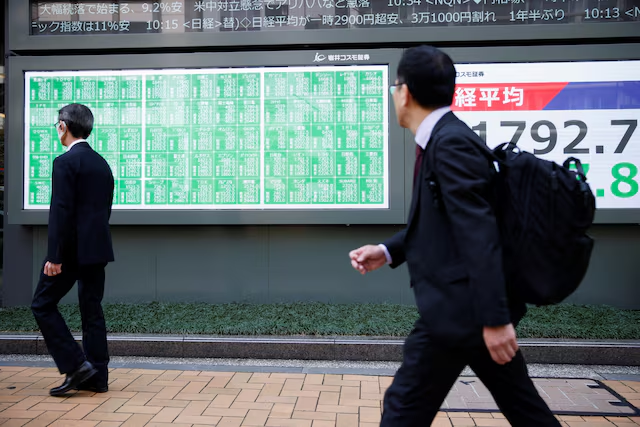
SINGAPORE, Aug 12 (Reuters) – Asian stocks mostly advanced on Tuesday, supported by news that the U.S. and China have extended their tariff truce, while Japanese shares surged to a record high, driven by technology stocks after a long weekend break.
U.S. President Donald Trump on Monday extended the tariff freeze with China by another 90 days, averting triple-digit duties on Chinese imports—a move widely anticipated by markets.
Recent investor optimism has been underpinned by expectations of U.S. Federal Reserve rate cuts, resilient U.S. corporate earnings, and greater clarity over trade policy.
Japan’s Nikkei jumped 2% to an all-time peak as markets reopened after Monday’s public holiday, in line with global index gains this year. Australia’s benchmark also reached a record high ahead of a central bank meeting where a rate cut is broadly expected.
MSCI’s broadest index of Asia-Pacific shares outside Japan edged slightly higher, while China’s blue-chip stocks were flat and Hong Kong’s Hang Seng dipped 0.1% in early trade.
Markets have remained within tight ranges in recent weeks, awaiting a definitive outcome on U.S.-China trade talks, which could either cement stability or reignite supply chain disruptions through renewed tariffs.
“The extension keeps the status quo for now, so there are no immediate implications for investment markets,” said Shane Oliver, chief economist and head of investment strategy at AMP in Sydney.
The tariff standoff has seen both nations exchange multiple rounds of levies this year, with negotiations in Geneva, London, and Stockholm since May focusing on reducing duties from triple-digit levels.
The latest extension shifts investor focus to a busy week featuring U.S. inflation data, Australia’s rate decision, and the first U.S.-Russia leaders’ summit since June 2021.
Traders are pricing in a 25 basis point rate cut from the Reserve Bank of Australia later Tuesday, with another expected by November. Attention will be on the bank’s guidance regarding future cuts.
“The uncertainty lies in whether it still sees room for more easing and how gradual that process will be,” Oliver added.
Global markets are also watching July’s U.S. consumer price index report due Tuesday. A Reuters poll expects core CPI to rise 0.3% month-on-month, faster than June’s 0.2%.
“CPI will be a key test for sentiment. Softer data could benefit small caps, but for now, mega-caps remain dominant,” said Marc Velan, head of investments at Lucerne Investment Management.
Stronger-than-expected inflation could temper expectations for Fed rate cuts this year. Markets currently anticipate at least two cuts in 2025, while J.P. Morgan projects four consecutive cuts beginning in September.
In commodities, gold traded at $3,354 after falling 1.6% on Monday when Trump confirmed tariffs would not apply to imported gold bars. Oil prices held steady ahead of the August 15 Trump-Putin meeting on Ukraine, with markets not expecting major breakthroughs but eyeing any geopolitical shifts that could affect commodities and emerging markets.
Currencies were steady, with the U.S. dollar unchanged against the euro and yen. Bitcoin and ether edged lower after gains in the prior session.


