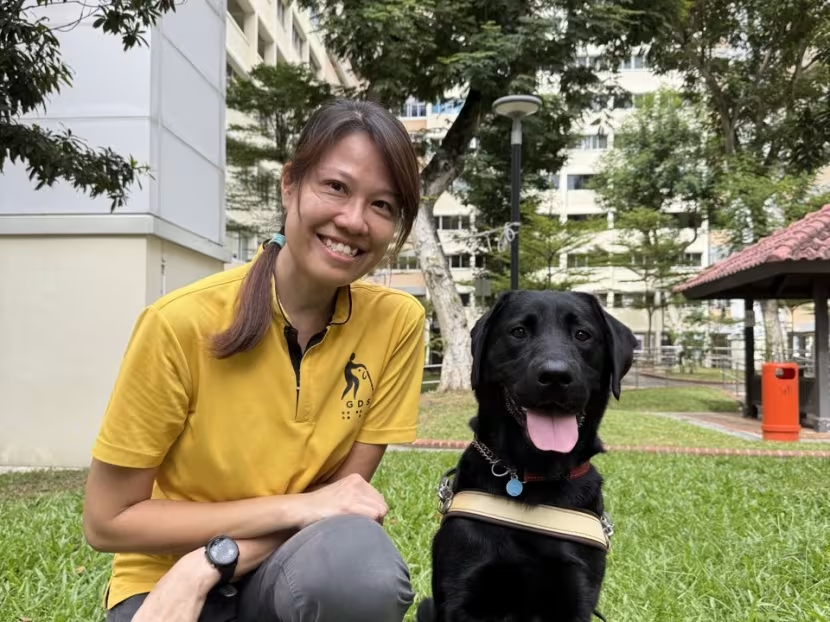
In Singapore, one woman is making it possible for the blind to move through the city with confidence and independence — one guide dog at a time.
Most mornings, 45-year-old Christina Teng can be found navigating footpaths, traffic lights, and MRT stations — not for her own commute, but to train a guide dog that will one day lead a blind person safely wherever they need to go. She is the country’s only full-time guide dog mobility instructor.
One of her clients, Manabu, lost much of his vision to the rare eye disease retinitis pigmentosa. Before his guide dog, Momo, travelling from Yishun to his workplace in Jurong East took over two hours — not because of the distance, but because navigating crowds, escalators, and obstacles with only a white cane was slow and exhausting. With Momo, trained by Teng, his commute now takes under an hour, greatly reducing stress.
“That’s the kind of difference a guide dog can make,” Teng says.
From Childhood Dream to Reality
Teng joined Guide Dogs Singapore in 2017, soon relocating to Melbourne for two-and-a-half years of intensive training with Guide Dogs Victoria before becoming certified. She returned home to train both dogs and their handlers — a role previously filled by short-term overseas instructors.
Her fascination began decades ago, sparked by a library book she found in primary school about guide dogs in the US and UK. But in 1990s Singapore, the field didn’t exist, so she became a social worker instead. Years later, in 2015, she saw a TV segment announcing that Guide Dogs Singapore was hiring instructors — and decided to revive her childhood ambition.
Finding the Perfect Match
Not every blind person is suited to a guide dog. Some prefer the tactile feedback of a white cane, which detects obstacles, while others prefer the proactive guidance of a dog that avoids them altogether.
Guide Dogs Singapore receives two or three enquiries a month. Potential handlers are assessed based on visual condition, lifestyle, daily routes, and living arrangements. The dogs — usually Labrador or golden retrievers — come from Australia or Japan, arriving at 12 to 14 months old for six months of local training before being matched.
“Like people, dogs have personalities too,” Teng says. “Some thrive in busy train stations, others in quieter neighbourhoods.” The matching process is deliberate — a two-hour meeting, a short walk, and careful observation of chemistry between dog and handler.
Training for Independence
Once matched, dog and handler train together for about a month, practising everyday routes such as trips to the supermarket, hawker centre, or bus interchange. Even after graduation, Teng continues to provide support, retraining dogs for new routes or helping handlers adjust after moving.
Providing one guide dog costs S$45,000 to S$50,000, fully funded by donations and grants. Handlers cover subsidised food and vet bills, with free grooming provided.
Changing Lives, One Step at a Time
While there are currently only nine active guide dog teams in Singapore, Teng says the impact on each individual is life-changing. One client, after years of avoiding solo walks, now shops for groceries independently. Another, who once avoided escalators entirely, regained the confidence to use them within six months of training.
Still, misconceptions remain. “Some people think guide dogs are dirty, aggressive, or shouldn’t be in public spaces,” Teng says. “But they’re working dogs, like police dogs, trained to remain calm and safe.”
She recalls an MRT incident where a distracted guide dog entered the train at the wrong moment, causing its blind handler to trip and injure her leg. “This is why it’s so important to give guide dogs and their handlers space to focus,” she stresses.
Looking Ahead
With an estimated 40,000 blind and visually impaired people in Singapore, the potential need is huge. Guide Dogs Singapore recently joined the International Guide Dog Federation, and by year’s end, Teng will be joined by another locally trained instructor.
“As much as possible, we want blind individuals to feel empowered,” she says. “If a guide dog is right for them, we’ll do everything we can to make it happen.”
Source: CNA


